
Business Phone
Canada continues to be one of the most preferred destinations for Indians looking to build a successful future. Whether your goal is quality education, better career opportunities, or permanent settlement, Canada offers multiple immigration pathways. However, many applicants often face one important question: Should they choose the Canada PR Process or apply for a Student Visa first?
The answer depends on your age, qualifications, work experience, financial situation, and long-term goals. Both pathways offer unique advantages and can eventually lead to a successful career in Canada. Understanding the differences between these options will help you make an informed decision.
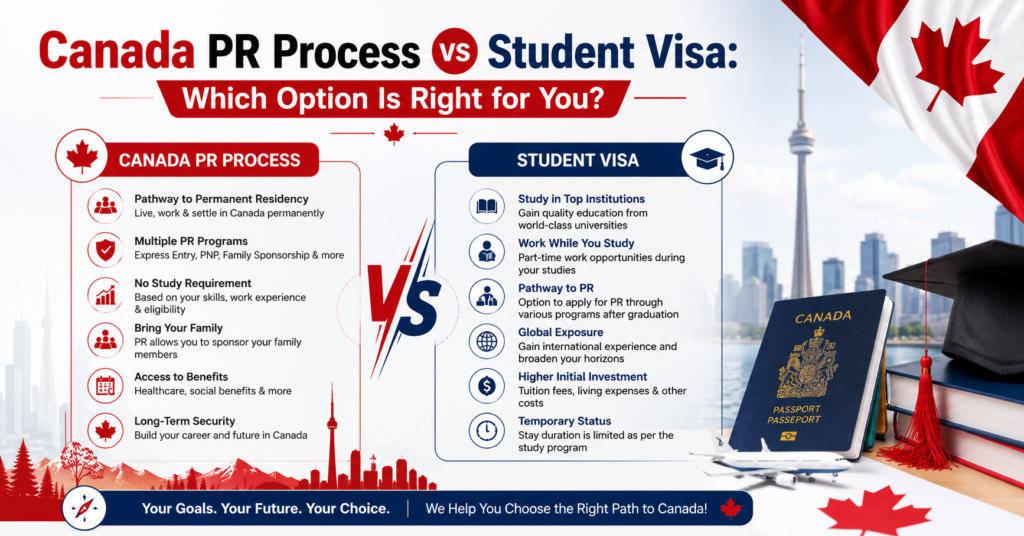
In this guide, we’ll compare the Canada Permanent Residency and the Student Visa pathway so you can determine which option best suits your future plans.
Understanding the Canada PR Process
The best Canada PR Process allows eligible foreign nationals to become permanent residents of Canada. Permanent residents can live, work, and study anywhere in the country while enjoying many of the benefits available to Canadian citizens.
There are several immigration programs through which applicants can obtain permanent residency, including:
- Express Entry
- Provincial Nominee Program (PNP)
- Family Sponsorship
- Atlantic Immigration Program
- Rural and Northern Immigration Programs
Each program has its own eligibility requirements based on education, work experience, age, language proficiency, and adaptability.
Benefits of Canada PR
Permanent Residency offers several long-term advantages:
- Live and work anywhere in Canada
- Access to healthcare benefits
- Opportunity to sponsor eligible family members
- Pathway to Canadian citizenship
- Freedom to change employers
- Better long-term career stability
For skilled professionals with competitive profiles, the top Canada PR Process can be the most direct route to settling in Canada permanently.
What is a Canada Student Visa?
A Canada Student Visa, officially known as a Study Permit, allows international students to pursue higher education at designated learning institutions (DLIs) in Canada.
Many students choose this route because it provides access to world-class education and can eventually create opportunities for permanent residency after graduation.
With a Study Permit, students can:
- Study at recognized Canadian institutions
- Work part-time during their studies
- Gain valuable international education
- Apply for a Post-Graduation Work Permit (PGWP)
- Build Canadian work experience
Canadian education often strengthens an applicant’s profile for future immigration programs.
Canada PR Process vs Student Visa
Understanding the key differences between these two pathways helps applicants choose the most suitable option.
Eligibility
The Canada PR Visa generally requires:
- Skilled work experience
- Language proficiency (IELTS/CELPIP)
- Educational credentials
- Competitive CRS score (for Express Entry)
A Student Visa mainly requires:
- Admission to a recognized institution
- Proof of financial support
- Valid passport
- Genuine intention to study
- Medical and background requirements
Cost
The Student Visa pathway involves:
- Tuition fees
- Living expenses
- Health insurance
- Visa application costs
The Canada PR Process typically involves:
- Language test fees
- Educational Credential Assessment (ECA)
- Immigration application fees
- Medical examination
- Proof of settlement funds
Although PR has its own costs, it eliminates the need to pay international tuition fees.
Time to Settle
Permanent Residency allows applicants to settle immediately upon arrival.
Student Visa holders usually:
- Complete their education.
- Apply for a Post-Graduation Work Permit.
- Gain Canadian work experience.
- Apply for Permanent Residency later through eligible immigration programs.
Which Option is Better?
There is no one-size-fits-all answer. The right pathway depends entirely on your profile.
Choose Canada PR if:
- You already have skilled work experience.
- You meet language requirements.
- Your CRS score is competitive.
- You want to settle permanently immediately.
- You have sufficient settlement funds.
Choose a Student Visa if:
- You want international education.
- You’re early in your career.
- You wish to improve future employment opportunities.
- You plan to gain Canadian work experience.
- You may later apply through the Canada Immigration after graduation.
Can a Student Become a Permanent Resident?
Yes. Many international students eventually become permanent residents.
A common pathway is:
- Complete higher education in Canada
- Obtain a Post-Graduation Work Permit
- Gain Canadian work experience
- Improve CRS score
- Apply through Express Entry or Provincial Nominee Programs
This route has become increasingly popular among Indian students because Canadian education and work experience often strengthen immigration applications.
How Eminent Overseas Can Help
Choosing between the Canada PR Process and a Student Visa can be challenging without expert guidance. Every applicant has a unique profile, and selecting the wrong pathway may lead to unnecessary delays or expenses.
Eminent Overseas provides personalized counseling to help applicants choose the most suitable immigration or education pathway based on their qualifications, career goals, and long-term plans.
Their services include:
- Canada PR eligibility assessment
- Express Entry guidance
- Provincial Nominee Program assistance
- Student visa consultation
- University selection
- Documentation support
- IELTS guidance
- Visa filing assistance
- Pre-departure counseling
With experienced consultants and a transparent process, Eminent Overseas helps applicants confidently pursue their Canadian dream.
Final Thoughts
Canada offers excellent opportunities through both permanent immigration and international education. The Canada Immigration Process is ideal for skilled professionals ready to settle permanently, while the Student Visa pathway is perfect for students seeking global education and future immigration opportunities.
Before making your decision, carefully evaluate your qualifications, finances, work experience, and long-term goals. Consulting experienced professionals can help you identify the pathway that best aligns with your aspirations.
Whether your goal is permanent residency or studying in Canada, Eminent Overseas provides expert guidance to help make your journey smooth, transparent, and successful.
Frequently Asked Questions (FAQs)
1. Which is better: Canada PR or a Student Visa?
It depends on your profile. Skilled professionals with strong qualifications may benefit from the Canada PR route, while students seeking international education often begin with a Study Permit.
2. Can I apply for Canada PR after studying in Canada?
Yes. Many graduates gain Canadian work experience through a Post-Graduation Work Permit and later apply for Permanent Residency through Express Entry or Provincial Nominee Programs.
3. How long does the Canada PR Process take?
Processing times vary depending on the immigration program, documentation, and government processing. Timelines can differ for Express Entry, PNP, and other pathways.
4. Does Eminent Overseas assist with both PR and Student Visas?
Yes. Eminent Overseas provides guidance for Canada PR applications, Express Entry, Provincial Nominee Programs, university admissions, student visas, and complete documentation support.
5. Can a Student Visa guarantee Permanent Residency?
No. A Student Visa does not automatically guarantee Permanent Residency. However, Canadian education and work experience can improve eligibility for various permanent immigration programs.